

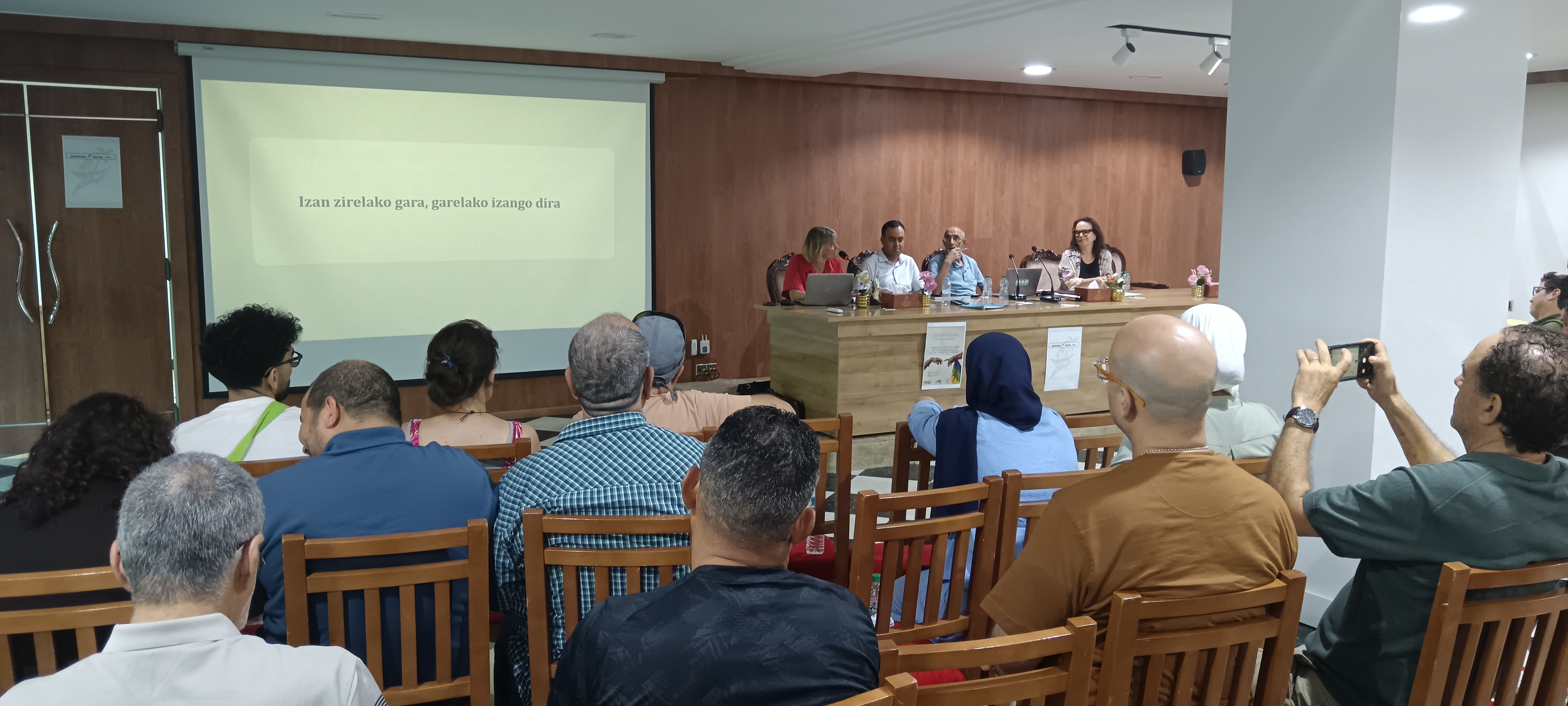
The city of Nador, in Morocco’s Rif region, became a meeting point in July for writers, educators, translators and activists working in Amazigh. It also provided a space for Basque and Amazigh participants to come together. On the North African shores of the Mediterranean, over four days participants discussed the challenges facing the language and the steps that need to be taken, while also learning about experiences in literature, translation and technology shared by participants from the Basque Country.
The A Nedder S Tutlaɣt-nneɣ, “We Live Through Our Language” gathering was a great success. According to the participants, the event marked an important milestone in addressing the challenges facing Amazigh in general and, more specifically, the Tarifit variety spoken in the Rif. Among other commitments, participants agreed to take significant steps forward in literature and publishing, and the gathering concluded with a firm commitment to strengthening the language in areas such as translation and Wikipedia.
July 9, the first day of the gathering, was devoted to helping participants get to know one another and strengthen their ties. They began with one of Garabide’s usual activities: participants paired up, spent some time getting to know each other and then introduced their partner to the rest of the group. From the outset, there was a lively atmosphere filled with humour and enriching conversations. In the words of Amazigh writer, journalist and organizer Chahid Andichi, “from those very first moments, it was clear that we had some wonderful days ahead of us.”
The following day, Amazigh publishing houses from southern, central and northern Morocco took the floor to share the experience they have accumulated over the years. Mirnetxu Ibargarai, a member of Plazara, also shared her experience in the field of children’s literature with the participants.
This was followed by one of the presentations that generated the greatest interest. Catalan writer Carles Torner, Vice-President of PEN International, one of the world’s largest writers’ associations, together with Urtzi Urrutikoetxea, a member of Garabide and Chair of PEN’s Translation and Linguistic Rights Committee, presented the organization’s work. Among other topics, they explained the work carried out with writers in minoritized languages and the initiatives that have been developed. The possibility of establishing an Amazigh PEN immediately generated considerable interest, and Torner and Urrutikoetxea explained that the Amazigh writers and creators present could themselves take the necessary steps to make it a reality.
Drawing on the Basque experience, participants also discussed how Amazigh could be incorporated into the education system. They also addressed the question of the most appropriate writing system for Amazigh and presented technological tools that can help bridge the Latin alphabet and the traditional Tifinagh script.
The third day continued with a focus on technology. Participants discussed how to integrate Amazigh into Artificial Intelligence tools. The Awal Digital experience from Catalonia was presented, along with automatic correction tools for Amazigh. In this context, Kepa Sarasola, a lecturer at the University of the Basque Country (EHU) and UEU, a member of the IXA research group and the Basque Wikimedians User Group, demonstrated his extensive experience in a highly practical way by creating new articles in Amazigh on the spot.
Participants then divided into groups to discuss literary projects and the challenges of translation into Amazigh. Translator Nahia Zubeldia also shared her experience through interesting examples of working with local varieties of Basque and the standard language.
The final day was devoted to writers. Most were Amazigh, naturally, but Ainara Maya Urrotz, Vice-President of the Basque Writers’ Association, also presented several initiatives from Basque literature, including Hatsaren Poesia and the Hugo Enea house in Pasaia.
Before the session came to an end, a tribute was paid to veteran university lecturer Abdelhadi Emharraf. Many of his former students are now leading figures in Amazigh research and culture, and they wanted to be present in Nador for the tribute.
Emotion, energy and a strong desire to work together came together throughout the gathering. The first tangible outcome emerged during the event itself: the intention to establish an Amazigh PEN, which was conveyed to PEN International in London. “Despite the tiredness, there was an energy that fuelled our passion for Tamazight,” recalls Chahid Andichi.
Tannemirt, thank you, eskerrik asko!




 2020 Garabide